


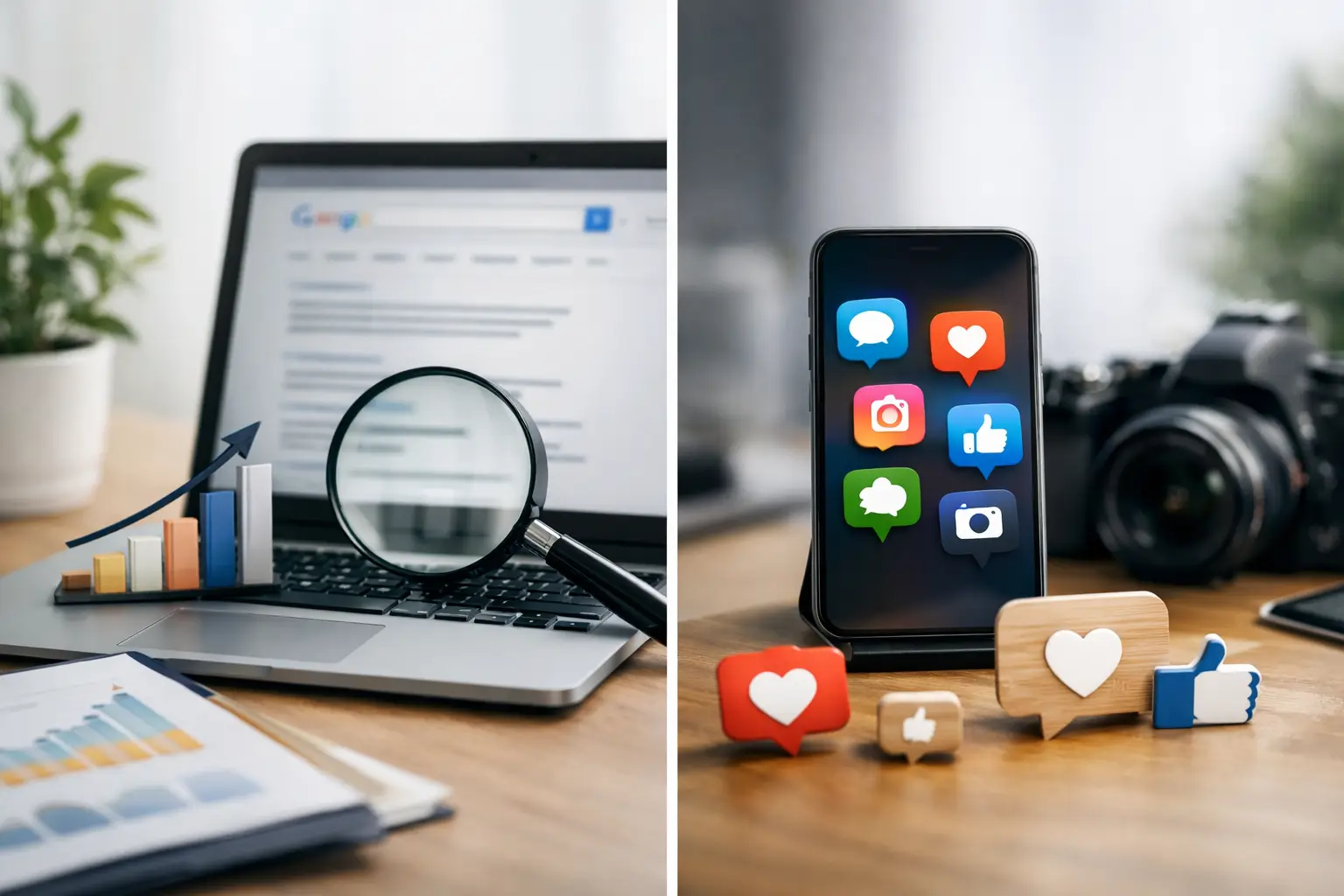
One channel compounds quietly for months. The other can move attention by this afternoon. That tension is exactly why the seo vs social media marketing debate keeps coming up for founders, marketers, and lean teams trying to grow without wasting budget.
The short answer is that neither one “wins” in every situation. SEO builds durable visibility around search intent. Social media marketing creates faster awareness, easier audience interaction, and more immediate feedback. If you’re deciding where to put limited time and money, the smarter question is not which is better in general. It’s which one fits your growth stage, sales cycle, and content capacity right now.
SEO vs social media marketing: the real difference
SEO is demand capture. It helps your business show up when people are already looking for answers, products, services, or comparisons. That built-in intent makes search traffic unusually valuable because users often arrive with a clear goal.
Social media marketing is demand generation and attention building. It puts your brand in front of people who may not be actively searching yet but can still become interested, engaged, and eventually ready to buy. Social platforms are also where brands build familiarity, voice, and community in public.
That difference matters because intent and attention are not the same asset. Search can bring people closer to action. Social can make people care enough to remember you.
Where SEO tends to outperform social
SEO usually wins when the business depends on consistent discovery over time. If you sell software, professional services, educational products, niche ecommerce items, or anything people research before buying, search can become one of the highest-leverage channels in your mix.
A strong article, category page, or landing page can keep producing visits and leads long after it goes live. That is the compounding advantage. You create once, optimize over time, and keep capturing interest from users with real intent. Social posts, by contrast, often have a much shorter shelf life unless they get exceptional engagement.
SEO also gives you more control over the destination. A search user lands on your site, your page, and your conversion path. You are not depending on a platform to decide whether 3 percent or 30 percent of your followers see your content this week.
There is a credibility benefit too. Ranking well for high-intent topics can make a business look established even if the company is still small. For many buyers, especially in B2B and high-consideration categories, strong search presence signals relevance and trust.
The catch is speed. SEO is rarely the fast lane. It takes time to build authority, publish useful content, improve technical performance, and earn visibility in competitive results. If you need leads next week, SEO alone will feel slow.
Where social media marketing tends to outperform SEO
Social media marketing is stronger when brand visibility, momentum, and audience interaction matter as much as direct intent. It is often the better choice for early-stage brands, visually driven products, personality-led businesses, creators, and companies testing positioning.
You can publish a message today, get reactions today, and learn today. That feedback loop is valuable. Social tells you which hooks work, which objections keep showing up, and what style of content gets people to stop scrolling. For a startup still figuring out messaging, that is hard to beat.
Social also works well for humanizing a brand. SEO can answer questions. Social can show personality, behind-the-scenes context, customer stories, and timely opinions. If your business grows through trust, relatability, or recurring attention, social has a clear advantage.
Then there is distribution. Great content does not automatically get discovered through search, especially when a site is new. Social can help put that content in front of an audience before organic rankings catch up. For publishers and media-focused brands, including platforms like Relionix, that amplification role matters.
The downside is volatility. Platform algorithms change, engagement can swing wildly, and audience attention is fragmented. You may build a following on one platform and still struggle to turn that attention into website traffic, email subscribers, or revenue.
SEO vs social media marketing on cost and ROI
This is where the debate gets more nuanced.
SEO often looks expensive upfront because it demands strategy, content production, technical cleanup, and patience. But once pages rank, the marginal cost of each additional visit can become very efficient. Over time, SEO can produce some of the strongest ROI in digital marketing, especially for evergreen topics.
Social media marketing can be cheaper to start, at least on the organic side. You can post consistently with limited tools and begin building visibility without waiting months. Paid social can also scale quickly if your creative and targeting are solid. That makes social attractive when you need faster signals.
But social ROI can be harder to sustain. Organic reach is inconsistent, and paid social performance can deteriorate as costs rise or creative fatigues. In other words, social often rewards constant activity. SEO rewards sustained investment in a library of useful assets.
If your team is small, this becomes a resource question. SEO usually needs better site infrastructure and stronger editorial discipline. Social usually needs faster production cycles, sharper creative instincts, and more day-to-day responsiveness.
Which channel fits your business stage?
For new businesses, social media marketing often makes more sense as the first push. You need visibility, audience feedback, and a way to test what resonates. Waiting for SEO alone to create traction can leave you invisible for too long.
For growing businesses with a validated offer, SEO becomes harder to ignore. Once you know what customers ask, search content can turn those questions into repeatable acquisition. This is where you stop chasing every spike in attention and start building a system.
For mature brands, the strongest play is usually not seo vs social media marketing as an either-or decision. It is using SEO for durable demand capture and social for reach, audience development, and content distribution.
There are exceptions. A local service business may get more value from search and reviews than from daily social posting. A fashion brand may gain far more from short-form video and creator-style content than from ranking blog articles. The right answer depends on how customers discover, evaluate, and trust your category.
The smartest strategy is usually a connected one
The highest-performing teams do not treat search and social as separate planets. They use each channel to strengthen the other.
A strong search article can become multiple social posts, short videos, carousels, or founder commentary. Social conversations can reveal the exact questions worth targeting through SEO. Content that earns engagement on social can signal which angles deserve a deeper page or article on your site.
This connected approach also improves efficiency. Instead of inventing content twice, you build one core idea and adapt it to different environments. Search content answers the long-form question. Social content creates curiosity, conversation, and return visits.
It also reduces risk. If rankings fluctuate, social still gives you audience access. If social reach drops, your search footprint still works in the background. That balance matters more now because every platform is less predictable than it used to be.
How to decide where to focus first
If your audience is already searching for what you sell, start by strengthening SEO. If your brand needs awareness before people even know to search for you, social deserves early priority.
If you have a website with useful content potential but little consistency, SEO may offer more long-term upside. If you have a strong voice, visual product, or founder presence that naturally earns attention, social may create faster traction.
Another practical filter is your sales cycle. Short, impulse-driven purchases can perform well on social. Longer, research-heavy decisions tend to benefit from search because buyers want comparisons, explanations, and proof.
And be honest about operating style. Some teams are great at publishing timely, engaging content every day. Others are better at creating fewer, higher-value assets that build over time. Choose the channel that fits your actual execution, not just the one with the best case study.
So which should you invest in?
If you can only choose one right now, choose the channel that matches buyer behavior and your capacity to execute consistently. That is more useful than following broad marketing dogma.
SEO is the better bet for long-term, intent-driven growth. Social media marketing is the better bet for speed, engagement, and brand visibility. Most businesses need both eventually, but they do not need both at the same intensity on day one.
A good growth strategy is not about picking sides. It is about building the next best source of traction without creating a hole somewhere else. Start where your customers already are, build what compounds, and let each channel make the other stronger.