


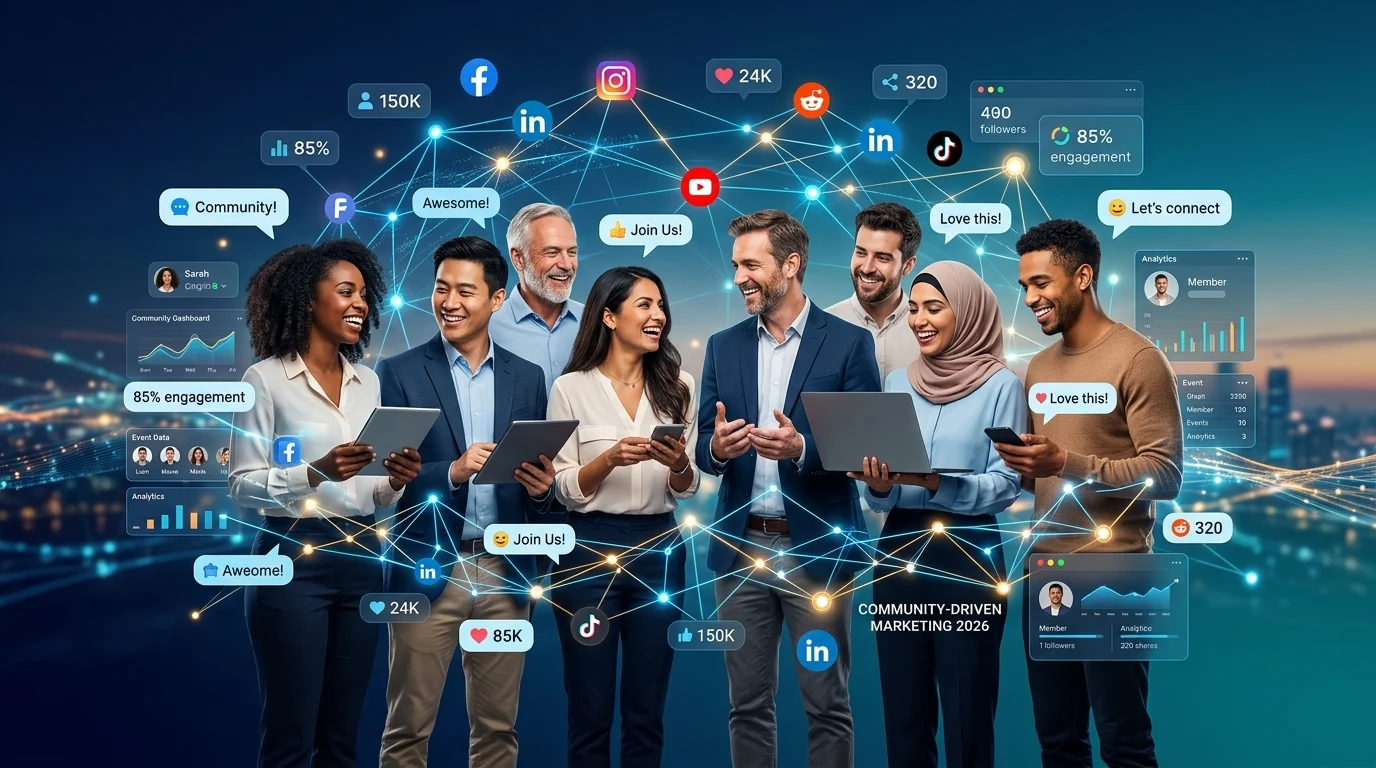

Here’s a wild thought:
What if your best marketing team isn’t your marketing team at all — but your customers? Welcome to community-driven marketing in 2026, where the brands winning the long game aren’t the ones spending the most on ads. They’re the ones building something people actually want to be part of.
If you’re a professional navigating the increasingly chaotic digital landscape, you’ve probably felt it — the old playbook isn’t working. Banner blindness is real. Influencer fatigue is real. And people are just tired of being marketed at.
So what is working? Community-led marketing. Let’s break it down — no fluff, no buzzword soup. Just the real stuff that moves the needle in 2026.
What Exactly Is Community-Driven Marketing in 2026?
At its core, community-driven marketing is a strategy where your customers, users, or fans become active participants in your brand’s growth — not just passive buyers. They create content, refer friends, share feedback, and do a lot of the heavy lifting that traditional marketing teams used to handle.
But in 2026, it’s evolved. It’s not just a Facebook Group you never check. It’s a deliberate, data-backed, AI-assisted ecosystem where connection and commerce reinforce each other.
Think of it this way: traditional marketing talks at people. Community-driven marketing talks with them. And that difference? It’s everything.
Community-Driven Marketing vs. Traditional Marketing
Here’s a quick side-by-side to clarify the contrast between community-based marketing (CBM) and the old school approach:
| Factor | Traditional Marketing | Community-Driven Marketing 2026 |
| Direction | One-way (brand → customer) | Two-way (brand ↔ community) |
| Primary Channel | Paid ads, TV, email blasts | Forums, Discord, social groups, events |
| Content Creator | Internal marketing team | Users + brand (UGC-heavy) |
| Trust Level | Medium — brand-generated | High — peer-to-peer |
| Cost Over Time | Scales up with spend | Scales with community size (lower CAC) |
| Loyalty Impact | Transactional | Emotional, identity-driven |
| Feedback Loop | Slow (surveys, focus groups) | Real-time, ongoing, organic |
See the pattern? Community-first marketing is not just a “nicer” version of marketing — it’s structurally more efficient. Lower customer acquisition cost (CAC), higher lifetime value (LTV), and a built-in content machine that never sleeps.
Why Your Brand Needs Community-Based Marketing Right Now
Let me be direct: if you’re still allocating 80% of your budget to paid acquisition in 2026, you’re playing a losing game. Here’s why community-based marketing has become non-negotiable:
- Ad costs keep rising. Google and Meta CPMs are up year-over-year. Communities give you a channel you actually own.
- Third-party cookies are dead. First-party data from your community is the new gold.
- Trust in brand advertising is at an all-time low. Peer recommendations in communities convert at 4–5x the rate of display ads.
- Gen Z and younger millennials choose brands they belong to — not just buy from.
- Community-driven growth compounds. Every new member makes the community more valuable for everyone else.
Bottom line: community isn’t a marketing tactic. It’s a competitive moat.
How to Build a Brand Community Online in 2026
Building a brand community isn’t just “starting a group.” There’s a real community-driven marketing strategy behind the brands that do this well. Here’s a simplified framework:
Step 1: Define Your Community’s Purpose
Ask yourself: Why would someone join this beyond just liking my product? The best communities are organized around a shared identity or goal — not just a brand. Think Peloton (fitness identity), Notion (productivity philosophy), or Duolingo (language learning pride).
Step 2: Choose the Right Platform for Community-Driven Marketing
Not all platforms are created equal for community engagement in 2026. Here’s a quick guide:
| Platform | Best For | Community Vibe |
| Discord | Creators, gaming, tech brands | Real-time, casual, niche |
| Mighty Networks | Coaches, course creators, niche brands | Structured, paid communities |
| Circle.so | Course-based brands, creators | Centralized, professional |
| Slack | B2B SaaS, professional communities | Work-adjacent, collaborative |
| Facebook Groups | Consumer brands, broad audiences | Familiar, easy to join |
| LinkedIn Communities | B2B, thought leadership | Professional, credibility-driven |
| WhatsApp / Telegram | DTC brands, high-touch engagement | Personal, high open rates |
Step 3: Create Value Before Asking for Anything
Drop the pitch. In community-first marketing, you give first. Share exclusive content, host AMAs, offer early access, celebrate member wins. Make people feel like insiders, not prospects.
Step 4: Empower Community Leaders
The fastest-growing communities identify their most engaged members and give them a role. Moderators, ambassadors, “founding members” — titles matter. Recognition matters. People rise to meet the expectations placed on them.
How to Turn a Customer Community Into a Growth Engine
This is where community-driven growth gets really interesting — and where most brands leave serious money on the table. Here’s the playbook for how to grow a brand using community marketing:
- UGC loops: Encourage members to create content about their experience. Reshare it. Tag them. This is free, authentic content that converts better than anything you create in-house.
- Referral mechanics: Reward members who bring in new members. Peer-to-peer referrals convert at 3–5x the rate of cold outreach.
- Product feedback pipelines: Use your community as a live focus group. Ask, listen, act, report back. When members feel heard, retention skyrockets.
- Community-exclusive offers: Members-only discounts, early launches, or beta access turn the community into a tangible value proposition — not just a nice-to-have.
- Live events (virtual or IRL): Events deepen emotional connections and spike engagement. Even a monthly Zoom call can do wonders for retention.
I’ve seen DTC brands reduce their paid ad spend by 30–40% after building active communities — not because they stopped acquiring, but because organic referrals and repeat purchases replaced a huge chunk of that volume. That’s the compounding effect of brand loyalty through community.
How AI Is Supercharging Community-Driven Marketing in 2026
Let’s talk about the elephant in the room: AI-powered community marketing in 2026. Yes, it’s a thing. And it’s genuinely useful — not just hype. Here’s how AI is being used right now to enhance community-led marketing:
- Sentiment analysis at scale: AI tools scan community conversations to surface emerging themes, frustrations, or product feedback — no manual reading required.
- Personalized community experiences: AI recommends relevant threads, members, or content based on individual behavior, making large communities feel intimate.
- Automated moderation: Tools like Sprinklr use AI to flag harmful content, spam, or off-brand conversations — critical when managing a community at scale.
- Content generation support: Community managers use AI to draft responses, FAQs, or weekly digests, saving hours every week.
- Predictive churn detection: AI identifies members who are disengaging before they leave — so you can intervene with a personalized touchpoint.
The smart move? Use AI as your community team’s assistant, not its replacement. The human warmth that makes communities thrive still requires a real person on the other end.
Community Engagement Metrics to Track in 2026
You can’t optimize what you can’t measure. Here are the community engagement metrics that actually matter for community-driven marketing in 2026:
| Metric | What It Measures | Why It Matters |
| Monthly Active Members (MAM) | % of members engaging monthly | Core health indicator — not just size |
| Member-Generated Content (MGC) | Posts, threads, UGC by members | Signals investment and brand advocacy |
| Net Promoter Score (NPS) | Would members recommend your community? | Predicts organic referral growth |
| Community-Sourced Revenue | Deals/conversions from community | Ties community directly to ROI |
| Retention Rate | % active after 30/60/90 days | Indicates lasting value delivery |
| Avg. Response Time | Time to answer member questions | Signals care and moderation quality |
| Ambassador Conversion Rate | % becoming active advocates | Measures top-of-funnel impact |
Pro tip: Don’t obsess over follower counts or group size. A community of 500 highly engaged members will outperform a sleepy group of 50,000 every single time.
How to Moderate and Manage a Brand Community at Scale
Managing a growing community is like hosting a dinner party that never ends. At some point, you need systems. Here’s what works for community management in 2026:
- Clear community guidelines: Set the tone early. What’s welcome, what’s not, and what happens when rules are broken.
- Tiered moderation: Combine AI-powered tools (Sprinklr, Sprout Social) for volume handling with human moderators for nuance and relationship management.
- Community health dashboards: Track sentiment, activity, and churn risk in real time — not just in monthly reports.
- Escalation protocols: Not every complaint is equal. Know when to escalate to your customer success or PR team.
- Prevent moderator burnout: Community management is emotionally demanding. Invest in your team’s well-being or risk losing your best people.
Community-Driven Marketing for Small Businesses on a Budget
Here’s something the big brands won’t tell you: community-driven marketing for small businesses is actually more powerful than it is for large enterprises. Why? Because authenticity is easier at small scale.
If you’re working with a lean budget, start here:
- Start with a free platform — a Facebook Group, WhatsApp group, or Discord server costs nothing.
- Engage personally. Reply to every comment. Know your members’ names. That personal touch is your unfair advantage over bigger brands.
- Leverage UGC marketing. Ask customers to share photos, reviews, or stories. Reshare everything. Make them feel famous.
- Co-create with your community. Let members vote on your next product color, name, or feature. They’ll promote what they helped build.
- Batch your community management time. Even 30 dedicated minutes a day can maintain a thriving community.
I’ve watched a small skincare brand grow from 200 customers to a community of 8,000+ passionate advocates — on a $0 community budget — simply by showing up consistently. That’s the magic of community-driven marketing in 2026.
Top Community Marketing Tools for 2026
Want to build and scale your community without losing your mind? Here are the best community marketing tools for 2026:
| Tool | Best For | Standout Feature | Link |
| Mighty Networks | Branded communities, courses | All-in-one: community + courses + events | mighty.networks |
| Circle.so | Course brands, creators | Seamless email & course integrations | circle.so |
| Discord | Niche communities, real-time chat | Voice channels + bots + deep customization | discord.com |
| Slack | B2B / SaaS communities | Workflow automation, integrations | slack.com |
| Sprinklr | Enterprise community management | AI-powered moderation at scale | sprinklr.com |
| Yotpo | E-commerce brands | Reviews + UGC + loyalty in one platform | yotpo.com |
| Sprout Social | Social-first communities | Community inbox + moderation tools | sproutsocial.com |
| Facebook Groups | Consumer brands, broad reach | Free + familiar ecosystem | facebook.com/groups |
Further Reading & External Resources
Want to go deeper? Here are some credible external resources on community-driven marketing worth bookmarking:
- LinkedIn Pulse — What Is Community Marketing?
- Digital Trainee — Social Media 2026: Community Marketing Trends
- INSEAD Knowledge — Seven Steps to AI-Powered Community Marketing
- CX Today — Best Customer Community Platforms 2026
- Social Plus Blog — What Is Community-Based Marketing (CBM)?
The Bottom Line: Community Is the New Moat
Community-driven marketing in 2026 isn’t a trend you can afford to ignore. It’s the logical endpoint of where marketing has been heading for a decade — away from interruption and toward belonging.
The brands that will dominate the next five years are the ones building places where people actually want to spend time. Not because they’re being targeted, but because being there gives them something: knowledge, connection, identity, or just the simple pleasure of being understood.
Your community is your most durable growth engine. It’s the channel you own, the trust you can’t buy, and the flywheel that compounds while you sleep.
So, what are you waiting for? Start small. Start honest. Start today. Pick one platform, find your first 50 true believers, and give them a reason to stay. The rest — the growth, the loyalty, the revenue — will follow naturally.
💡 Ready to build your brand community in 2026?
Share this article with your marketing team, bookmark it for your next strategy session, and drop a comment below: What’s the #1 challenge your brand faces when building community?
We read every response — because yes, we practice what we preach.