

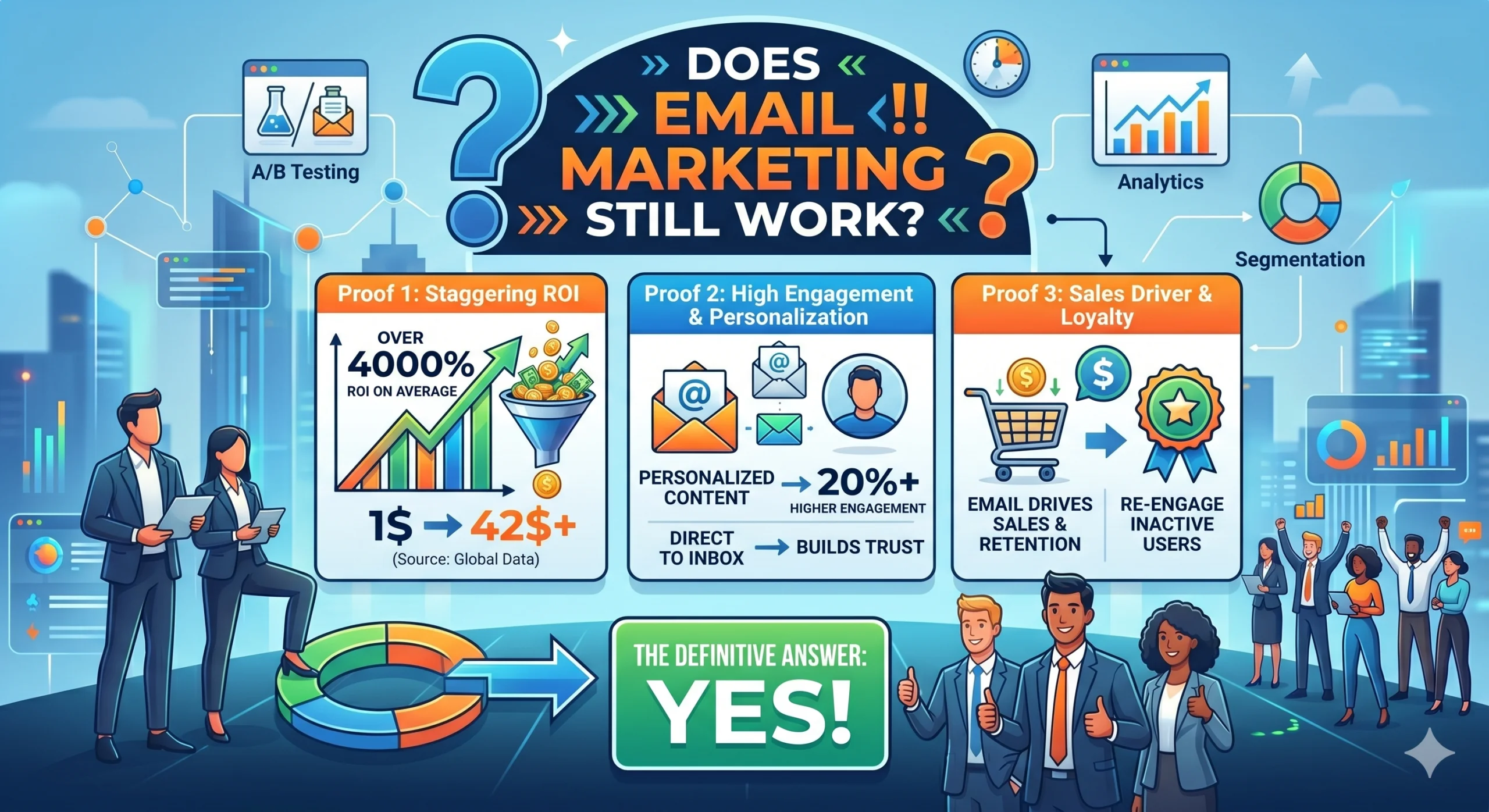
Every year, someone declares email marketing dead. Every year, the numbers prove them wrong. But here is the real question: does email marketing still work for your business, the way you are doing it right now? That answer is different — and it matters more than any industry statistic.
If you are a small business owner asking whether email is worth your time in 2026, this guide gives you a straight answer — backed by what is actually working, what has changed, and the three mistakes that make email feel useless.
The honest answer: yes, but not the way most businesses do it
Email marketing still delivers one of the highest returns of any marketing channel available to small businesses. For every dollar spent, businesses report an average return of around $42. That figure has stayed consistent for years — through social media booms, algorithm changes, and the rise of AI tools.
But that number hides a brutal truth: the average is pulled up by businesses doing email well. The businesses dragging it down are the ones sending the same newsletter to everyone on their list every two weeks and wondering why nobody opens it.
Email works. Outdated email strategy does not. The difference comes down to three things we will cover in detail below.
What has changed about email marketing in 2026
Before getting into what works, it helps to understand what has shifted — because the email landscape in 2026 is genuinely different from five years ago.
Inboxes are more competitive
The average person receives over 120 emails per day. Your subject line is competing not just with other businesses but with news alerts, personal messages, and promotional tabs that most email clients now filter automatically. Getting into the inbox is harder. Getting someone to open is harder still.
AI personalization is now standard, not advanced
Platforms like Mailchimp, Klaviyo, and Constant Contact have built AI features directly into their free and entry-level plans. These tools help you send the right email to the right person at the right time — automatically. Businesses that used to need a marketing team to run personalized campaigns can now do it solo. If you are not using at least basic segmentation in 2026, you are already behind.
Privacy changes have reshaped open rate data
Apple Mail Privacy Protection, introduced in 2021 and now widely adopted, means open rates are no longer a reliable metric. Many emails show as “opened” even when they were not. This is not a death sentence for email — it just means smart marketers have shifted focus to click rates, reply rates, and actual conversions rather than open rates alone.
Automation has become the real competitive edge
The businesses seeing the strongest results from email in 2026 are not the ones sending the most emails. They are the ones with smart automation running in the background — welcome sequences, abandoned cart reminders, re-engagement campaigns, and post-purchase follow-ups that work 24 hours a day without anyone pressing send. If you are only sending manual campaigns, you are missing half the value of email.
3 reasons email marketing feels like it is not working (and the fix for each)
If you have tried email marketing and felt like it was not worth the effort, one of these three issues is almost certainly why.
1. You are sending the same message to everyone
Imagine walking into a shop where the salesperson gave the exact same pitch to every single customer — the first-time visitor, the loyal regular, and the person who almost bought last week but did not. That is what most businesses do with email.
Segmentation is the practice of dividing your email list into groups based on behaviour, interests, or where someone is in their journey with your business. Even basic segmentation — separating new subscribers from existing customers — can double your click-through rate almost immediately.
The fix: Start with three simple segments. New subscribers (people who joined in the last 30 days), active customers (people who have bought in the last 90 days), and cold subscribers (people who have not opened an email in 90 days or more). Send each group something different. The new subscribers need a welcome and an introduction to what you do. Active customers need value and loyalty recognition. Cold subscribers need a re-engagement offer or to be removed entirely.
2. Your emails are not mobile-optimised
More than 60% of emails are now opened on mobile devices. If your email looks broken, too small to read, or requires horizontal scrolling on a phone, it gets deleted within two seconds — often before the reader has seen your message at all.
The fix: Use a single-column layout. Keep subject lines under 50 characters so they do not get cut off on phone screens. Make your call-to-action button large enough to tap with a thumb (at least 44px tall). Test every email on mobile before you send it — most email platforms have a preview mode that shows you exactly what it looks like on different devices.
3. You have no automation running
Manual email campaigns — the kind where you sit down and write a newsletter each week — are valuable. But they are only half of what email can do for your business. The other half is automation: sequences that trigger based on what a subscriber does or does not do.
The fix: Set up these three automations first, in this order:
- Welcome sequence — a series of 3 to 5 emails sent over the first two weeks after someone joins your list. Introduce yourself, share your best content, and make one clear offer.
- Re-engagement campaign — triggered when a subscriber has not opened or clicked in 90 days. One honest email asking if they still want to hear from you. This cleans your list and often wins back customers you had written off.
- Post-purchase follow-up — sent 3 to 5 days after a customer buys. Ask for a review, offer related products, or simply say thank you. Businesses that do this consistently see significantly higher repeat purchase rates.
These three automations, once set up, run indefinitely without any ongoing effort. That is where the real ROI of email marketing comes from.
What email marketing actually looks like when it works
Here is a practical picture of what good email marketing looks like for a small business in 2026 — not a Fortune 500 company, just a real business with a real list.
| What they do | Result |
|---|---|
| Send one value-focused email per week | Consistent touchpoint, builds trust over time |
| Segment list into 3 groups | Higher relevance, better click rates |
| Run a welcome sequence for new subscribers | New leads get context, faster conversion |
| Clean list every 90 days | Better deliverability, accurate metrics |
| Track clicks, not just opens | Accurate view of what content drives action |
None of these things require an expensive tool or a dedicated marketing hire. They require a clear strategy and consistent execution — which is exactly what separates businesses that say email works from those who say it does not.
The best email marketing tools for small businesses in 2026
Choosing the right platform makes everything easier. Here are the options worth considering for small businesses, based on ease of use, value, and features available at the entry level.
Mailchimp — best for beginners
Mailchimp remains the most recognisable email platform for a reason. The free plan supports up to 500 contacts and 1,000 emails per month, which is enough to get started and test your strategy before committing to a paid plan. The drag-and-drop builder is genuinely easy to use, and the automation features — including a basic welcome series — are available even on free plans. It is not the most powerful tool at scale, but for a business just getting started with email, it is hard to beat.
Klaviyo — best for businesses with products
If you sell products — physical or digital — Klaviyo is worth serious consideration. Its automation capabilities are more sophisticated than Mailchimp, particularly around purchase behaviour: it can trigger emails based on what someone bought, how much they spent, and how long it has been since their last order. The free plan covers up to 250 contacts, and the paid plans are priced based on list size rather than features, meaning you get the full tool from day one.
ConvertKit — best for content creators and service businesses
ConvertKit is built for businesses where the owner is the brand — coaches, consultants, freelancers, and content creators. Its tagging and segmentation system is intuitive, its automation builder is visual and easy to understand, and its focus on plain-text emails (which often get higher deliverability) suits service businesses well. The free plan supports up to 1,000 subscribers.
Brevo (formerly Sendinblue) — best for budget-conscious businesses
Brevo offers one of the most generous free plans available: unlimited contacts with up to 300 emails per day. For a small business that wants to build its list without a monthly cost, this is exceptional value. The platform also includes SMS marketing, live chat, and a basic CRM in the free tier — making it a strong all-in-one starting point.
How to write emails people actually open and read
The best email strategy in the world falls apart if the emails themselves are not worth reading. Here are the principles that consistently produce strong results for small businesses.
Write subject lines like a human, not a marketer
The subject lines that get the highest open rates in 2026 tend to be specific, curious, or conversational — not promotional. “3 things I wish I knew before running my first ad campaign” outperforms “Our biggest sale of the year — don’t miss it!” every time for a small business audience.
Test two subject lines whenever your platform allows it. After a few months of testing, you will have a clear picture of what resonates with your specific audience — and that knowledge is more valuable than any industry benchmark.
Lead with value, not with selling
The businesses with the most loyal email audiences operate by a simple rule: for every email that asks for something, send three or four that give something first. Useful tips, honest observations, behind-the-scenes content, answers to common questions. This builds the kind of trust that makes a promotional email actually work when you do send one.
Keep it short unless you have a reason to go long
Most marketing emails should be under 300 words. If you need to say more — a full guide, a story, a detailed tutorial — link to it from the email rather than putting everything in the email itself. This also gives you a click to track, which tells you far more than an open rate ever could.
One call to action per email
Emails with multiple calls to action — “buy this, read this, follow us here, and share this with a friend” — convert worse than emails with a single, clear next step. Decide what you want the reader to do and make that one thing obvious. Everything else is a distraction.
How to grow your email list as a small business
An email strategy is only as strong as the list behind it. Here are the methods that consistently work for small businesses without requiring a big budget.
Offer something genuinely useful in exchange for an email
A lead magnet — a free resource, checklist, template, or short guide — gives potential subscribers a clear reason to hand over their email address. The key word is genuinely useful. A generic “sign up for our newsletter” prompt converts at around 1 to 2%. A specific offer — “download the 5-step checklist we use with every new client” — converts at 5 to 15% or higher.
Add a sign-up form to high-traffic pages
Most small business websites have a sign-up form buried in the footer where almost nobody sees it. Place your form — with your lead magnet offer — at the end of your most-read blog posts, in the middle of long-form content, and as an exit-intent pop-up. Each placement should explain exactly what the subscriber will receive and how often.
Ask existing customers directly
Your happiest customers are often not on your email list simply because you never asked. A short email to current customers — explaining what they will get and how often — is one of the fastest ways to build a high-quality list. People who already trust you enough to pay you are far more likely to open and engage with your emails than cold leads.
Measuring email marketing results the right way
With open rates now unreliable due to privacy changes, here are the metrics that actually tell you whether your email marketing is working.
- Click-through rate (CTR) — the percentage of recipients who clicked a link in your email. A healthy CTR for small businesses sits between 2% and 5%. Above 5% is excellent.
- Conversion rate — how many email clicks resulted in the action you wanted (a purchase, a booking, a form completion). This is the number that ties directly to revenue.
- List growth rate — how fast your list is growing minus unsubscribes. If your list is shrinking, your acquisition strategy needs attention before anything else.
- Revenue per email sent — total revenue attributed to email divided by the number of emails sent. This single number tells you more about the health of your email strategy than any other metric.
- Unsubscribe rate — if more than 0.5% of recipients unsubscribe after a single campaign, the content or frequency is off. Treat a high unsubscribe rate as immediate feedback, not a failure.
Common email marketing mistakes to avoid
Beyond the three main issues covered earlier, here are the mistakes that consistently hold small business email performance back.
- Buying email lists. Purchased lists have terrible deliverability, damage your sender reputation, and often violate spam laws. Every contact on your list should have opted in voluntarily.
- Never cleaning your list. Sending to inactive subscribers hurts your deliverability over time. Remove or re-engage contacts who have not interacted in six months.
- Sending too infrequently. If you only email your list twice a year, subscribers will have forgotten who you are by the time you send. Consistency matters more than frequency — even once a month is better than twice a year.
- Ignoring the preview text. The preview text — the short line that appears next to your subject line in most inboxes — is valuable real estate that most small businesses leave blank or allow to auto-populate with generic filler. Write it intentionally, every time.
- Making it hard to unsubscribe. A visible unsubscribe link is not just legally required in most countries — it is also good for your list health. Subscribers who want to leave will either unsubscribe or mark you as spam. The former is far less damaging.
Does email marketing still work — the final verdict
Email marketing works in 2026. It works better than most social media channels for direct engagement. It works better than paid ads for customer retention. And it works at a fraction of the cost of almost every other marketing channel available to small businesses.
What does not work is treating email like it is 2015 — blasting the same newsletter to everyone, ignoring mobile, and skipping automation entirely.
The businesses getting strong results from email right now are doing three things consistently: they segment their list, they automate their core sequences, and they write emails that lead with value before asking for anything in return.
Start there. The rest is refinement.
Next steps for your email marketing
If you are ready to build a stronger email strategy, here are some resources on Relionix that go deeper on the topics covered in this guide:
- CRM vs Email Marketing: What Matters More? — understand how your CRM and email platform should work together
- How to Choose Marketing Automation Tools — a framework for picking the right automation platform for your business size
- Customer Retention Strategies for Small Business — email is one of the most powerful retention tools when used correctly
- Digital Marketing Strategy for Small Business — see how email fits into a complete marketing strategy
- How to Build Customer Trust Online — the principles behind email content that converts